
What Makes Gold-Plated Jewelry Durable? A Guide for Jewelry Brands
Quick Answer
Gold-plated jewelry fades because the gold layer is thin, and once it wears through or lets moisture past, the base metal underneath starts to show and react. Thickness is part of how long that takes—but it is not the whole answer. Surface preparation, plating-process control, handling between steps, finishing, and the locations where friction lands on the product all affect the result. This is why two pieces with a similar stated plating thickness can perform very differently in real wear, and why “make it thicker” often does not fix a fading problem on its own.
Why Plating Thickness Isn’t the Whole Story
Thickness is the number in the specification, so it is the number buyers anchor on. It is also the easiest thing to ask a supplier for and the easiest thing for a supplier to agree to. The honest answer is that thicker plating can help, but it is rarely the whole fix—and sometimes it is not the fix at all.
A plating layer is only as good as what it is bonded to. Gold deposited onto a surface that still has polishing compound, oil, or oxide on it will not adhere the way the same gold deposited onto a properly prepared surface will. The micron reading can come back the same. The wear behavior will not.
Thickness determines how much material is there to wear through. Everything else determines whether that material stays attached, stays even, and stays intact in the places that actually get rubbed. A thick layer with poor adhesion can fail earlier than a thinner layer with excellent adhesion and a well-prepared base.
Surface Preparation Before Jewelry Plating
This is the part of the process buyers almost never ask about, and it is the part we would point to first when plating underperforms. Before any gold goes on, the base metal has to be smooth enough, clean enough, and chemically receptive enough for deposition to happen evenly across the whole piece.
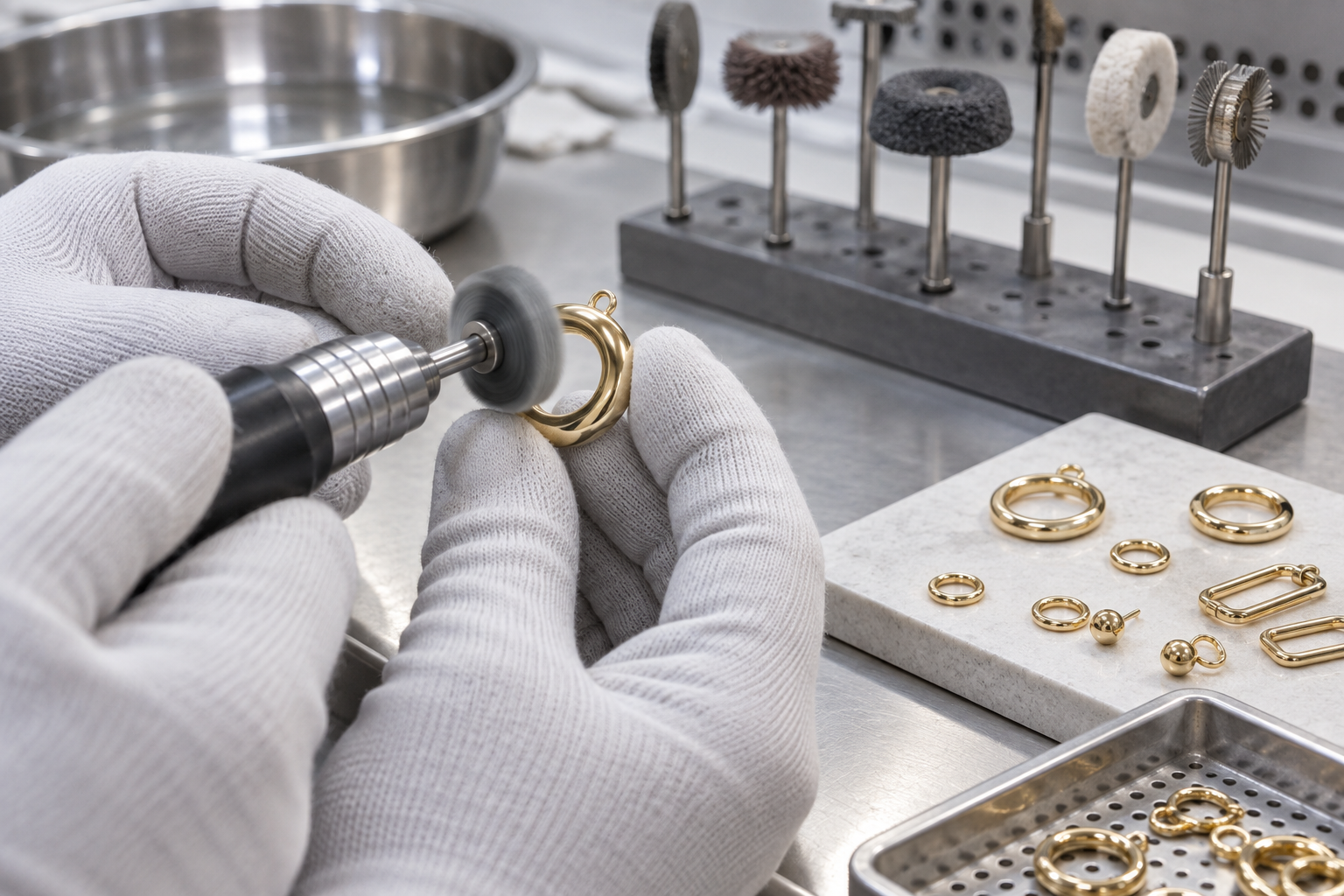
Polishing and surface condition. Plating follows the surface it is applied to. It does not fill in scratches, tool marks, or an uneven finish—it coats them. An uneven surface creates uneven wear points, and those become the first places the finish breaks down.
Removing polishing residue. Polishing compound collects in recesses, joints, around settings, and inside chain links. Residue left in those areas can create adhesion problems that do not show up on a visual inspection of a new piece, but do show up in wear.
Degreasing, cleaning, and oxide removal. Handling oils and surface contaminants sit on the metal as a barrier. The required preparation varies by substrate, which is one reason the same plating specification can behave differently on different base metals.
Coating a poorly prepared surface does not solve what is underneath it. It covers it. The gold layer will do what the surface beneath it allows it to do, and no thickness specification overrides that.
How the Jewelry Plating Process Affects Durability
Once the surface is ready, the plating process introduces another set of variables.
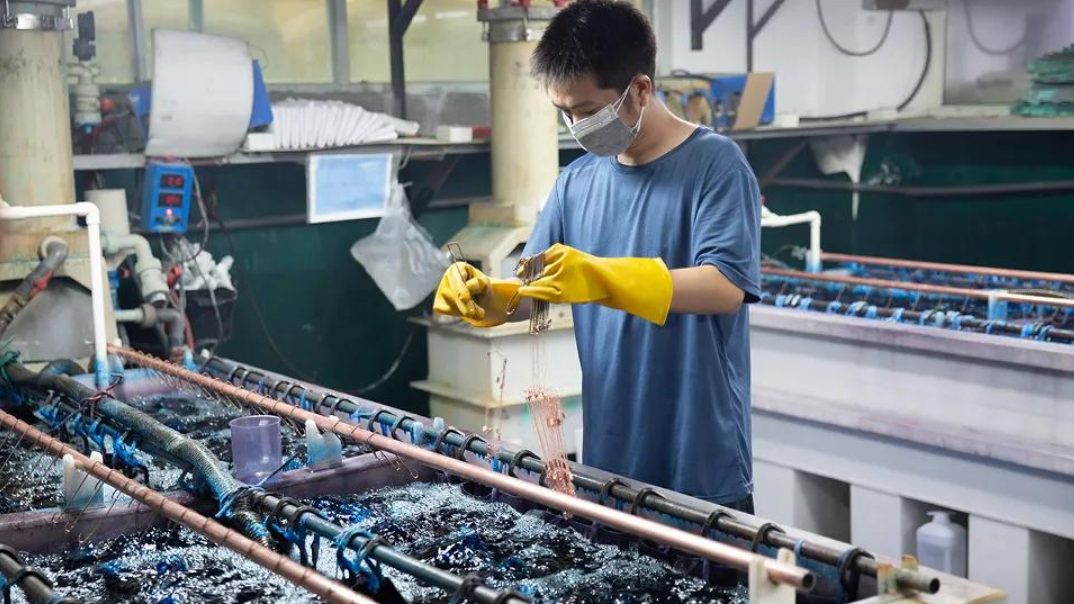
Plating method. Electroplating and PVD are different processes with different characteristics, and they suit different products and substrates. The method choice is a real variable, not a marketing label.
Layer structure. Gold is often not applied directly onto the base metal. An intermediate layer can improve adhesion, provide a smoother deposition surface, or act as a barrier between the base metal and the outer layer, depending on the coating system.
Process consistency. Bath condition, current distribution, part positioning, and rack loading affect how evenly coating deposits across a batch and across the geometry of one piece. A specification may say “1 micron,” but production determines whether that micron is present evenly in recessed areas and on edges.
Handling and sequence. Pieces get touched, moved, racked, and transferred between stages. Contamination introduced after cleaning but before plating undoes the cleaning. Steps that are correct individually can still produce a poor result if timing and sequence allow contamination or oxidation at the wrong moment.
Longer plating time is not automatically better plating. More time in the bath can add material, but it does not correct poor preparation, uneven current distribution, or contamination. Process control is what produces a consistent result.
Why Edges, Chains and Clasps Fade First
Wear patterns are rarely random. They concentrate in the same places because of geometry plus friction rather than plating failure in the general sense.
- Edges and raised details: harder to coat evenly and the first surfaces to contact clothing, skin, and other objects.
- Chain links: many small components rub against each other continuously.
- Clasps and moving components: handled directly at every wear and subject to mechanical contact.
- Rings and bracelet contact points: exposed to especially demanding abrasion in everyday use.
Wear location is partly a design decision, not only a plating decision. Edges, chain construction, clasp choice, and contact area all influence where and how fast a finish shows wear.
PVD vs Electroplating: Why the Process Matters
Electroplating deposits metal from a solution using electrical current. PVD (physical vapor deposition) applies coating material in a vacuum environment. In jewelry, PVD is commonly used for gold, rose-gold, and black finishes, particularly on stainless steel.

One process is not automatically more durable than the other. Coating performance depends on the complete system: substrate, preparation, coating composition, process control, coating uniformity, and the product’s geometry. A well-executed electroplated finish can outperform a poorly executed PVD finish, and vice versa. The practical question is which process suits this product, on this substrate, for its intended use—and how well the chosen process is actually controlled.
Finishing and Protective Layers After Plating
After plating, some products receive additional finishing or a protective top layer. Where used, these can contribute to surface protection and to how the finish holds up in wear and handling. A protective layer is not a substitute for the steps before it: a topcoat over a poorly adhered plating layer protects a poorly adhered plating layer.
How Base Metal Changes the Plating System
The substrate changes what preparation is required, what layer structure makes sense, and how the finished piece behaves as the coating wears.
Stainless steel is durable and corrosion-resistant as a base. It has its own surface characteristics that affect preparation and coating adhesion, and it is commonly used with PVD finishes. If stainless steel is under consideration, the grade decision is worth working through separately: 304 vs 316L stainless steel jewelry.
Brass is widely used in plated jewelry and plates well, with good casting flexibility for detailed shapes. Because it is a copper alloy, the exposed base can react and discolor when coating wears through.
Sterling silver is used for gold-plated pieces positioned closer to fine jewelry, with its own preparation and finishing considerations. The correct preparation and coating sequence is not universal; it depends on what is underneath.
How Brands Should Specify Plating to a Jewelry Manufacturer
“18K gold plated” describes a color and a general method. It does not describe the base metal, preparation, layer structure, thickness, finishing, or quality standard. Depending on the product, a useful plating specification may cover:
- Base material, including grade where relevant
- Plating method and target thickness where required
- Gold tone and an approved physical color reference
- Surface finish and layer structure
- Protective finish or topcoat, if required
- Intended wear conditions and high-friction areas
- Testing requirements and an approved sample reference
These points should be agreed before sampling, not raised after a production batch arrives.
Plating Quality Control
Plating QC is partly visual and partly specification-based. A new plated piece can look good almost regardless of how well it was made, so inspection must be tied to the agreed process and sample.
- Color consistency across pieces, batches, and the approved reference
- Coverage in recessed areas, chain links, and around settings
- Surface defects such as pitting, spotting, cloudiness, blistering, or unevenness
- Finish consistency and inspection of high-friction contact areas
- Adhesion and thickness verification where the product and specification require it
For the general inspection framework, see our guide to jewelry quality control.
How We Approach Plating at Yu&An
When a brand sends us a plated jewelry project, we do not start with the requested thickness. We start with what the thickness is going to sit on: base material, surface condition and polishing, cleaning and preparation, the coating process for the product’s geometry, finishing, and the areas likely to take friction during wear. Thickness is part of that conversation, not its start and end.
When an existing product is fading, useful diagnostic questions are: What is the base metal? How was it prepared? Is fading uniform or concentrated at edges, links, and clasps? Does it appear across the whole batch or only part of it? Does the current specification describe a coating system, or just a color and a number?
For custom development more broadly, see OEM/ODM jewelry manufacturing.
What Buyers Should Ask Before Approving a Plated Jewelry Sample
- What is the base material, and what grade?
- What plating method is being used?
- What plating thickness is specified, and where is it measured?
- How is the surface prepared before plating?
- Is there an intermediate layer or protective finish?
- How is plating color controlled between batches?
- Which areas will take the most friction, and how are they handled?
- What QC checks and approved physical reference will be used?
Testing a finish at a small quantity before committing to a full production run is practical. Learn more about low-MOQ and no-fixed-MOQ custom jewelry manufacturing.
Developing or Fixing a Gold-Plated Collection
If you are developing a gold-plated collection, or trying to work out why an existing one is not holding up, send us product photos, close-ups of wear or fading, the base material, current plating specification, target finish, and a reference sample where available. We will review the base material, surface preparation, coating process, finishing, and friction points on the design to identify where the issue may sit.
Frequently Asked Questions
What should a brand do when a customer complains that the gold plating is fading?
Investigate before concluding. Ask when fading was first noticed, which part is affected, how the piece was worn, and request clear photos. Then compare the original product specification and approved sample with the evidence. Visible fading can have several causes; the investigation identifies which one applies.
Does a fading complaint always mean the plating was too thin?
No. Thickness is relevant, but base material, surface preparation, coating consistency, geometry, friction, finishing, and wearing conditions can all contribute. Increasing thickness on a piece whose real problem is adhesion or coverage can produce another disappointing batch.
What information should a brand send to the manufacturer when investigating a plating problem?
Send clear product photos, the style or SKU, base material, plating method and stated thickness, color or finish reference, approved sample, batch reference, where fading appears, approximate wearing time and conditions, and whether the issue affects one piece, several, or the whole batch.
Why does plating wear differently on rings, chains, edges and clasps?
Product construction determines where contact happens. Rings take abrasion from everyday use, chain links self-abraid, clasps have moving contact surfaces, and edges are both harder to coat evenly and the first surfaces to meet clothing and skin.
How can brands reduce the risk of plating problems before mass production?
Confirm the base material and grade, process and finish, an approved physical color reference, relevant thickness requirements, surface preparation, high-friction areas, an approved representative sample, and the inspection or testing approach before mass production.


Add comment