
PVD Coating Jewelry Manufacturing: A Practical Guide for Jewelry Brands
Quick Answer
PVD jewelry manufacturing covers a lot more than the coating step itself. It starts with a production-ready base piece and proper surface preparation, moves through vacuum coating, and then depends heavily on how color and coverage are confirmed on a sample and carried into bulk production. For a brand, the factors that often influence whether a project goes smoothly are the ones rarely discussed upfront: how well the coating covers a piece’s actual geometry — chain links, cutouts, prongs, recessed areas — and whether the color and finish approved on a sample are locked to a physical reference before mass production begins, rather than described only in words or photos.
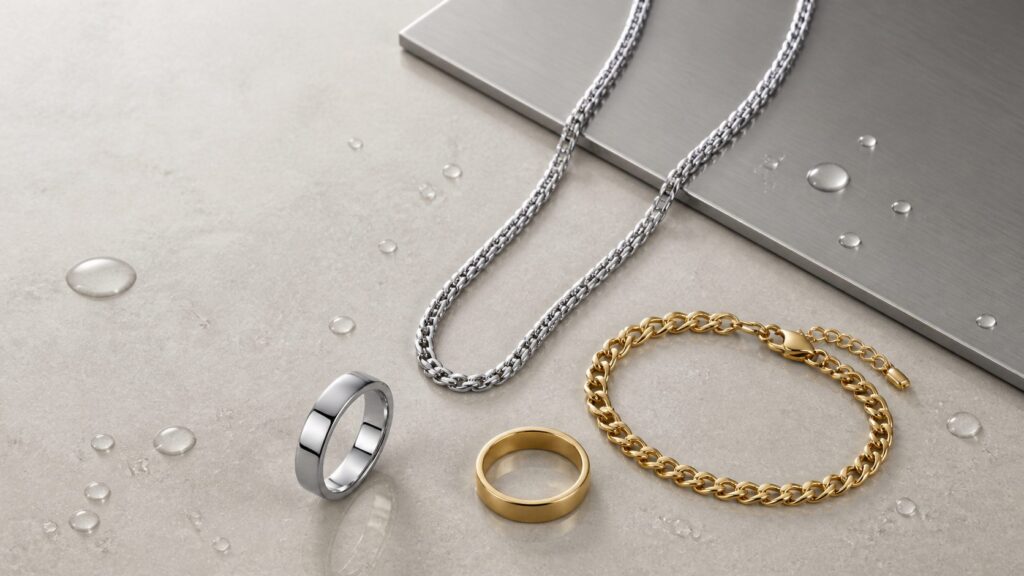
What PVD Jewelry Manufacturing Actually Involves
PVD (physical vapor deposition) is a vacuum-based coating process in which coating material is converted into a vapor phase and deposited onto the jewelry surface as a thin film. It’s a fundamentally different process from electroplating, which deposits metal from a solution using electrical current — that distinction matters for how a piece is prepared and how the finish behaves, and we’ve covered it in more depth in our guide to gold-plated jewelry durability, since a lot of the surface-preparation logic carries over between the two processes.
For a jewelry project specifically, PVD sits in the middle of a longer sequence: the base piece is designed and fabricated, the surface is prepared, the piece goes through coating, the color and coverage are confirmed against a sample, and then — if everything holds — that same result has to be reproduced across a full production run. Many explanations of PVD focus on the coating step because that’s the part with the interesting physics. For a brand, coating is one part of a larger manufacturing system; the surrounding preparation, geometry, approval, and production steps also matter.
Base metal matters going into this process. Stainless steel — 304, 316, and 316L — is a common base for PVD jewelry, and brass is also used depending on the project. We work with these materials depending on what a design calls for; if stainless steel is the substrate and grade selection matters for the project, that’s worth a separate conversation — see our guide to 304 vs 316L stainless steel jewelry — since grade affects corrosion behavior independent of the coating on top of it.
Surface preparation before coating follows the same logic we’ve written about for plating generally: PVD doesn’t fill in a rough or inconsistent surface, it coats it, and any polishing marks, residue, or surface irregularities present before coating will still be there — often more visible — afterward. We won’t repeat that discussion in full here; it’s covered in gold-plated jewelry durability.
What’s specific to PVD, and less commonly discussed, is what happens next: how coverage behaves across a real piece of jewelry, and how color gets confirmed and held consistent from a sample into bulk production. Those are the two areas this guide focuses on.
Jewelry Geometry and Coating Coverage
This is the part of PVD that generic “what is PVD” content may overlook, because it’s specific to jewelry rather than to PVD as an industrial process in general.
PVD is a vacuum deposition process, and coating material travels from a source to the surface being coated. That means coverage depends on how exposed a given surface is within the chamber — a flat, open face is straightforward to coat evenly. Jewelry geometry is rarely that simple.
Chain links sit against each other and move during handling, which means each link partially shadows its neighbors. A chain can be more challenging to coat evenly than a flat pendant of the same size, simply because many surfaces are in close contact with other surfaces.
Cutout and pierced designs — open lattice patterns, negative-space letters, filigree-style work — create edges and interior surfaces that are harder to expose evenly than a solid piece. The inside edge of a cutout can behave differently from the outer surface of the same piece.
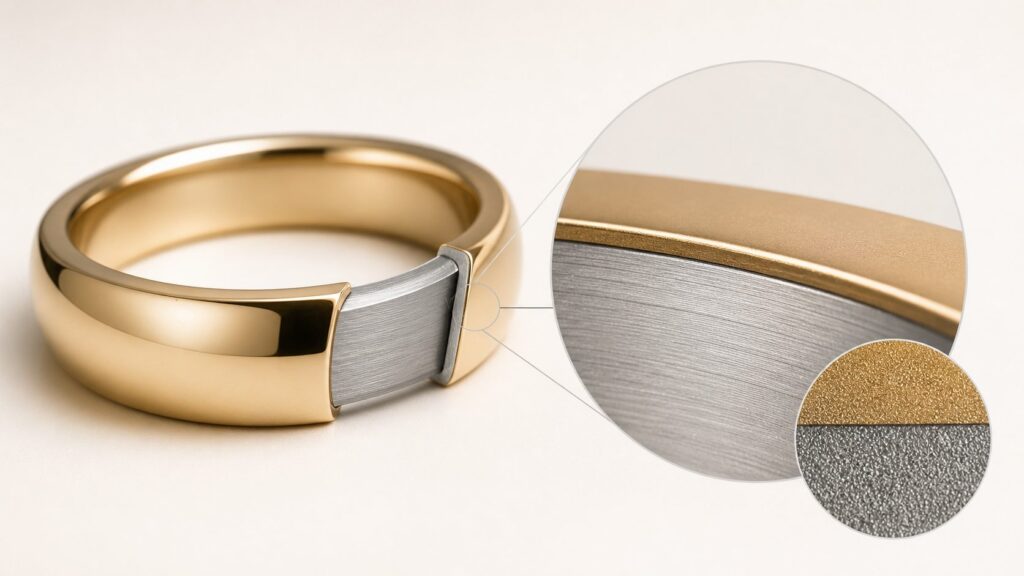
Prong settings and raised details create their own shadowing: the underside of a prong, or the recessed area where a stone sits, is a different coating environment than the flat top of the same piece.
Contact and fixture points — wherever a piece is held or racked during coating — are a physical necessity of the process, and depending on where they fall on the design, they’re worth understanding at the design stage rather than discovering on an inspected sample.
This doesn’t mean PVD can’t be used on complex jewelry designs — it is used for chains, filigree, and set stones. It means that coverage is a design and production planning question, not just a coating-step question. A design with deep recesses, dense linkage, or significant negative space is a different coating project than a simple flat charm, even if both are labeled “PVD gold.” For a product developer, this is worth raising with a manufacturer at the design stage — before tooling and sampling — rather than after a sample comes back with visible unevenness in areas that can be more challenging to coat.
Color Reference and Sample Approval
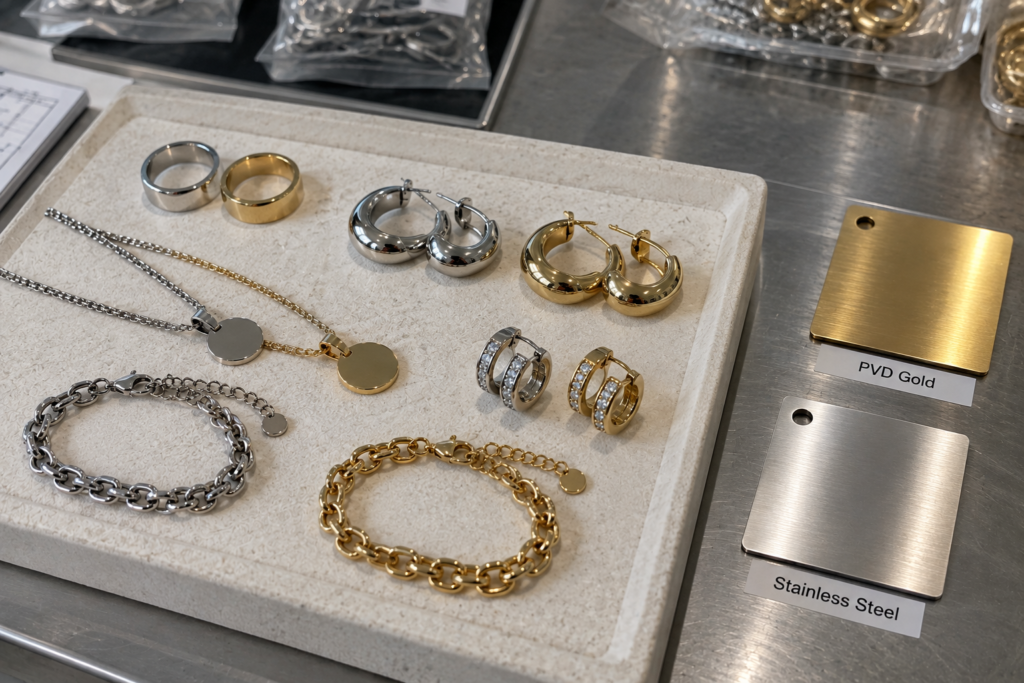
PVD color isn’t limited to traditional gold. Depending on the project, PVD can produce gold tones, rose gold, black, and silver or other metallic finishes, and — where a brand’s design calls for it — colored finishes such as blue, green, or multicolor effects may also be achievable. The point worth understanding here isn’t a list of colors; it’s that “PVD gold” describes a category, not a specific, reproducible color.
This is where a lot of sample-approval processes are weaker than they should be. A verbal description — “18K gold,” “warm rose gold,” “matte black” — is not a production reference. Neither, on its own, is a photo or a screen image, both of which shift with lighting, camera settings, and display calibration. These alone may not provide enough information for a production run to be matched against reliably.
What helps anchor a PVD sample approval is a physical retained sample plus a color reference — an approved physical piece, ideally alongside a color reference card or swatch, that becomes the thing bulk production is measured against. This is the approach we use: when a sample is approved, the retained piece and its color reference become the production standard, not the written description of what was requested.
Sample approval, done properly, should confirm three things together, not just one: the color, matched against the physical reference rather than a description; the coverage, checked across the piece’s actual geometry — recesses, links, undersides — not just its most visible flat surfaces; and the finish, whether high-polish, matte, or another surface effect, consistent across the whole piece. A sample that’s approved on color alone, without the coverage and finish being checked with the same attention, is an incomplete approval — and problems that show up later in bulk production may already have been present in the sample, just not looked for.
From Sample to Bulk Production: Where Consistency Can Break Down
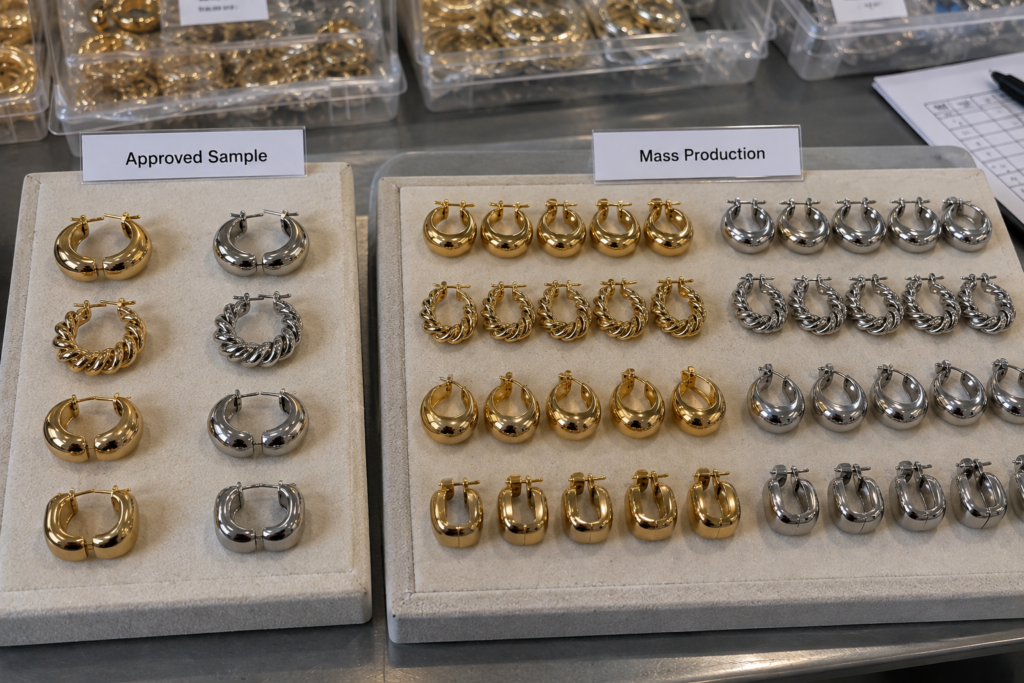
A sample that looks right doesn’t automatically mean a bulk order will match it. This is one of the more common and less discussed risk points in PVD jewelry production, and it’s less about the coating chemistry and more about what happens to the reference between sample approval and full production.
The core risk is drift — small, usually unintentional, shifts in color, surface finish, or coverage between what was approved and what ships in volume. A few things commonly contribute to this. Judgment can shift over the course of a larger run: without a fixed physical reference actively used for comparison, “close enough” can gradually move away from what was originally approved, batch by batch, without anyone deciding that it should. Surface preparation consistency can vary more across a large run than it did across a small sample batch, simply because more pieces means more opportunities for inconsistency in polishing or cleaning. And coverage issues tied to a design’s geometry — the same chain-link shadowing or recess exposure discussed above — don’t go away at volume; if a design is difficult to coat evenly, that difficulty can be present in every piece of the bulk run, not just the sample.
One practical safeguard against this drift is the same one that should have anchored sample approval in the first place: a retained physical sample and color reference that stays in active use through the production run, not just filed away once the sample was approved. When bulk production is checked against a physical reference rather than a memory of what the sample looked like, drift can be easier to catch early rather than after a full shipment has been produced.
For a brand, the practical takeaway is this: the sample-approval stage isn’t just a step to get through before placing a bulk order. It’s where the actual production standard gets defined — and how that standard is carried forward, not just what it looked like on day one, helps determine whether a bulk order matches the sample a brand approved.
PVD vs Electroplating, Briefly
PVD and electroplating are different processes — PVD deposits material in a vacuum, electroplating deposits it from a solution using electrical current — and each has its own behavior in terms of adhesion, typical use cases, and how it interacts with different base metals. Neither process is automatically more durable than the other in every case; performance depends on the full coating system, not the process name alone. We’ve covered that comparison in more depth in our guide to gold-plated jewelry durability, including how base metal, surface preparation, and process control can affect outcomes for both. This guide focuses on what’s specific to running a PVD project well, rather than re-litigating that comparison.
Quality Control for PVD Jewelry, at a Glance
Building on the sample-approval and consistency discussion above, ongoing QC for PVD jewelry generally checks: color consistency against the approved physical reference, across pieces and across batches; coverage, specifically in the geometry-sensitive areas discussed earlier — recesses, links, undersides — not just the easily visible surfaces; and finish consistency, confirming that gloss, matte, or other surface effects hold steady across a run. A full framework for how we approach jewelry inspection more broadly is covered in our jewelry quality control guide; PVD-specific QC builds on that same foundation, with coverage and color reference as important areas for this particular process.
How We Approach a PVD Jewelry Project
When a brand brings us a PVD jewelry project, we don’t treat coating as a separate step handed off at the end. Jewelry manufacturing and PVD coating are coordinated as one project — from the base piece’s design and construction, through surface preparation, into coating, and through to sample approval and bulk production.
Our PVD coating work runs through our affiliated plating facility. This working relationship helps us coordinate jewelry production with coating requirements, including design, base-metal decisions, surface preparation, and the coating stage, as one connected project.
We work with 304, 316, and 316L stainless steel, along with brass, depending on what a project calls for. On color, PVD development with us isn’t limited to traditional gold tones — rose gold, black, silver, and colored finishes are possible development directions depending on the project and the brand’s design intent.
For color and sample confirmation, our practice is the one described above: an approved physical sample together with a color reference becomes the standard bulk production is measured against, rather than a verbal description or a photo. We think this is one of the more overlooked parts of a PVD project, and it’s the part we pay close attention to — because it’s usually where the gap between “the sample looked right” and “the bulk order matched it” can be addressed.
What Buyers Should Send When Requesting a PVD Jewelry Quote
- A design or reference image for the piece
- Preferred base material, if you have one (stainless steel grade, brass, or open to a recommendation)
- The color or finish direction you’re aiming for — and any existing reference (an existing physical sample, color card, or other agreed color reference) if you have one
- The product type and construction — chain, ring, pendant, charm, earring, and whether the design includes cutouts, prongs, or other detail that affects coating coverage
- Estimated quantity
- Any timeline considerations
Sending this upfront shortens the early back-and-forth considerably, particularly on color direction and construction details that affect how a design will actually coat.
What to Check Before Approving a PVD Sample
- Does the color match an agreed physical reference — not just a verbal description or a photo?
- Is coverage even across the piece’s actual geometry, including recesses, links, undersides, and other areas that are harder to expose evenly — not just the most visible flat surfaces?
- Is the finish (high-polish, matte, or otherwise) consistent across the whole piece?
- Is the approved sample being physically retained as the production reference, alongside a color reference card or swatch, rather than just photographed and filed?
- Has the manufacturer confirmed how that reference will be used to check bulk production once it starts?
A sample approved against these points is a production standard. A sample approved on visual impression alone is a good first look, not a production reference.
Developing a PVD Jewelry Collection
If you’re developing a PVD jewelry collection — a new design, a new color direction, or a first PVD run for your brand — send us your design or reference, target material, color and finish direction, product type, and estimated quantity, and we’ll work through coverage, color reference, and sample approval with you before bulk production begins. Contact Yu&An to get started.
Frequently Asked Questions
What affects whether PVD coating covers a jewelry piece evenly?
Coverage depends on the piece’s geometry as much as the coating process itself. Chain links, cutout or pierced designs, prong settings, and recessed areas can be harder to coat evenly than a flat, open surface, because PVD is a vacuum deposition process and coating material has to reach exposed surfaces. This is a design and production-planning consideration, worth discussing before sampling, not something to discover afterward.
Why isn’t “18K gold PVD” enough of a color specification?
Because it describes a category of color, not a specific, reproducible one — and verbal descriptions, photos, and screen images all shift with lighting, camera settings, and display calibration. A reliable specification uses a physical approved sample together with a color reference card or swatch as the standard, rather than relying on words or images alone.
Why can a PVD sample look perfect but the bulk order look different?
This can be a drift problem rather than a coating-chemistry problem. Without a fixed physical reference actively used for comparison throughout the run, color, finish, or coverage judgment can shift gradually across a larger production batch. Keeping the approved sample and color reference in active use — not just approving it once and moving on — can help reduce this risk.
How is PVD jewelry manufacturing different from electroplating?
PVD deposits coating material in a vacuum, while electroplating deposits it from a solution using electrical current. They’re different processes with different adhesion characteristics and typical use cases, and neither is automatically more durable in every situation — performance depends on the full coating system. A fuller comparison is covered in our guide to gold-plated jewelry durability.
What should a brand provide when requesting a PVD jewelry quote?
A design or reference image, preferred base material if you have one, your target color or finish direction (with a physical or visual reference if available), the product type and construction, estimated quantity, and any timeline considerations. Construction details — especially anything involving chains, cutouts, or prongs — matter for coating coverage, so flagging them upfront helps a manufacturer assess the project accurately.


Add comment